
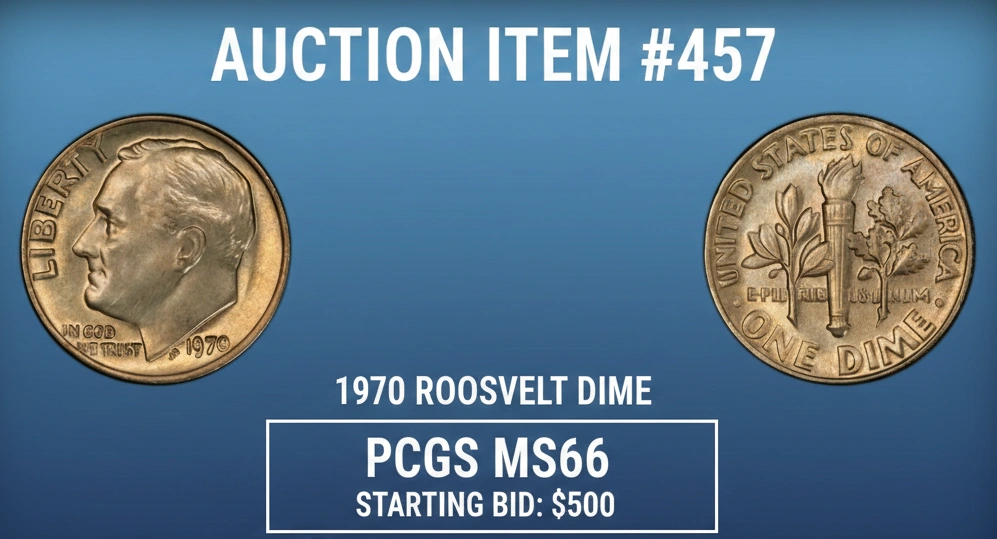
Transitioning away from silver composition just five years prior, the 1970 Roosevelt dime represents a stabilized era of cupro-nickel clad technology.
The United States Mint faced the challenge of producing massive quantities of coinage while maintaining the electromagnetic signatures required by the expanding vending machine industry.
The 1970 issue utilizes a complex sandwich structure consisting of a pure copper core fused to outer layers of 75% copper and 25% nickel.
Bonded through a high-pressure rolling process, these layers are designed to resist delamination even under extreme circulation wear.
All the details and features affect the 1970 dime value dramatically.

Attribute | Philadelphia | Denver | San Francisco |
Mintage | 345,570,000 | 245,407,400 | 2,632,810 |
Quality | Business Strike | Business Strike | Proof |
Rarity (FB) | Extremely Rare | Scarce | N/A |
Auction Record | $2,415 (MS67FB) | $881 (MS67FB) | $329 (PR70DCAM) |
Composition | Cupro-Nickel Clad | Cupro-Nickel Clad | Cupro-Nickel Clad |
Metallurgical analysis of 1970 planchets reveals a consistent hardness profile, although variations in the annealing process occasionally resulted in "soft" strikes.
These soft strikes are particularly prevalent in the Philadelphia production runs, complicating the search for high-definition specimens.
The 1970 date remains a focal point for researchers studying the mid-cycle performance of the Roosevelt design dies.
Distributing the manufacturing load across three primary facilities, the 1970 production cycle fulfilled distinct economic and numismatic roles.
The Philadelphia Mint, operating without a mint mark for this denomination, produced 345,570,000 specimens.
This facility often prioritized volume over strike quality, leading to the high frequency of coins with blurred details on the reverse torch.
The Denver Mint manufactured 245,407,400 units, identifiable by the "D" mark located just above the date on the obverse.
Data from major grading services suggests that Denver strikes from 1970 typically exhibit superior luster compared to their Philadelphia counterparts.
The San Francisco Mint focused on the collector market, producing 2,632,810 Proof quality coins.
These Proof units were sold exclusively in five-coin sets, featuring a mirrored background and frosted relief.
Total combined mintage reached 593,610,210 units, ensuring the coin's ubiquity in American commerce for decades.
The primary criterion for identifying a 1970 dime with elite market value is the "Full Bands" designation.
This technical standard focuses on the two sets of horizontal bands holding the torch on the reverse of the coin.
Achieving a Full Bands (FB) or Full Torch (FT) status requires a complete, uninterrupted separation between the upper and lower lines of both band sets.
Statistics provided by PCGS and NGC highlight a massive scarcity in this category for 1970-P dimes.
Less than 0.05% of certified 1970 Philadelphia dimes have been awarded the Full Bands designation.
The primary cause of this scarcity involves the rapid degradation of the reverse dies.
Striking nearly 600 million coins necessitated the use of dies long after their optimal detail-producing life had passed.
A standard MS67 specimen without Full Bands might trade for $20, whereas an MS67FB specimen can command four-figure sums at specialized auctions.
Collectors looking for these coins must use at least 10x magnification to verify that the separation is not obscured by minor contact marks or "planchet chatter."
Analyzing the financial trajectory of the 1970 dime requires a look at specific high-grade transactions over the last twenty years.
The market for these coins is segmented into high-volume circulation strikes and low-volume, high-grade rarities.
1970-P MS67FB (PCGS): A notable specimen sold for $2,415 in 2019 via Heritage Auctions. This transaction set a benchmark for the Philadelphia issue, highlighting the extreme premium placed on strike clarity.
1970-D MS67FB (PCGS): Realized $881 in a 2014 sale. The lower price relative to Philadelphia reflects the higher survival rate of well-struck Denver coins.
1970-P MS67 (Non-FB): These coins typically sell for $40 to $65, illustrating that the "Full Bands" attribute accounts for over 95% of the coin's value at this grade level.
1970-S PR70 Deep Cameo (PCGS): While the record price hit $329 in 2013, current market values have settled near $125. The increasing number of PR70 certifications has diluted the scarcity, leading to a downward price correction of approximately 4% annually.
Tracking the price of 1970-P MS66FB coins shows a stable valuation between $250 and $400, acting as a more accessible entry point for technical collectors.
Market volatility for 1970 dimes is generally low, except when a new "top-pop" (highest population) coin is discovered and certified.
Mechanical errors occurring during the 1970 production run provide essential data for understanding the Mint's operational tolerances.
Errors in this category arise from the failure of the centering mechanism during the feed cycle.
Specimens missing 10% to 20% of the design are relatively common, often found in original bank-wrapped rolls.
Pieces missing 50% or more of the design while retaining a clear 1970 date are highly valued.
Market prices for 50% off-center 1970 dimes range from $150 to $310, depending on the presence of the mint mark.
These defects occur when the blanking press punches a planchet from a portion of the metal strip already missing a circular section.
Clipped planchet 1970 dimes are categorized by the shape of the clip: curved, straight, or ragged.
A 1970 dime with a significant curved clip (15-20% of the coin's mass) sells for $35 to $60.
Occurring when the retaining collar fails to engage, broadstruck coins expand beyond their standard 17.91 mm diameter.
These coins lack edge reeding and often exhibit a "pancaked" appearance with distorted lettering near the rim.
Technical values for broadstruck 1970 dimes remain stable at $15 to $30.
Tracking the 1970 dime's performance reveals a steady decline in the value of mid-grade Proof coins.
Between 1990 and 2010, 1970-S PR69 specimens dropped in value by 45% due to the increased volume of certified sets.
Conversely, the value of MS67FB Philadelphia coins increased by 210% over the same period.
This divergence highlights the "Two Markets" mentioned in the title: the saturated Proof market and the scarce high-grade business strike market.
Data from 2024 indicates that MS64 and MS65 grades have reached a price floor, trading exclusively as bulk numismatic material.
Investment-grade activity is now focused almost entirely on the MS67 and MS67+ segments for both P and D mints.
The 1970 ten-cent coin represents a high-volume industrial product with rare technical exceptions.
Statistical evidence from grading populations confirms that Philadelphia strikes are significantly more difficult to find in "Full Bands" condition than Denver strikes.
Financial returns on this issue are tied directly to the "Plus" designations and Full Bands attributes.
Technical collectors prioritize the 1970 dime for its metallurgical stability and its role as a baseline for early clad-era coinage studies.
The separation between the face-value circulation units and the multi-thousand-dollar rarities defines the modern numismatic status of the 1970 Roosevelt dime.

Art has the power to captivate, inspire, and transform. Behind every breathtaking piece of art is a journey that begins with a simple sketch and evolves into a stunning masterpiece. The process of cre...
Read more
Learn expert tips and techniques for photographing your coin collection with clarity and style. From essential gear to creative examples, discover how to make every coin shot shine with precision, usi...
Read more

Learn how to create stunning, art-inspired fashion pieces at home! From finding inspiration and gathering materials to designing, personalizing, and showcasing your work, this guide covers everything ...
Read more
Find your valuable 1982 penny! Learn how to weigh Copper (3.11g) vs. Zinc (2.5g) types, find the rare Small Date, and check the high prices of perfect coins....
Read more